



Predictive AI for churn can flag customers who may leave. Yet a risk score alone doesn’t retain anyone. The real value appears when your team links an early prediction to an action that changes the customer’s decision.
That sounds obvious, but many churn projects stop at model accuracy. Teams celebrate a dashboard that identifies likely cancellations. Meanwhile, the retention program may contact customers too late, offer discounts to people who would have stayed, or ignore payment failures that marketing cannot fix.
This guide shows how to commission a useful churn system. You’ll learn how to separate voluntary and involuntary churn, choose signals, design interventions, and measure incremental retention.
What predictive AI for churn actually does
A churn model estimates the probability that a customer will leave within a defined period. For example, a subscription business may predict cancellation within the next thirty days. A B2B software company may estimate whether an account will fail to renew this quarter.
The model learns from earlier customer behavior. For example, useful signs may include falling product use, fewer orders, open service issues, failed payments, lower email use, or a recent downgrade.
However, the score only ranks customers by estimated risk. A customer with an eighty percent risk score may stay, while one with a lower score may leave. Therefore, marketers should use risk bands and action rules while allowing for uncertainty.
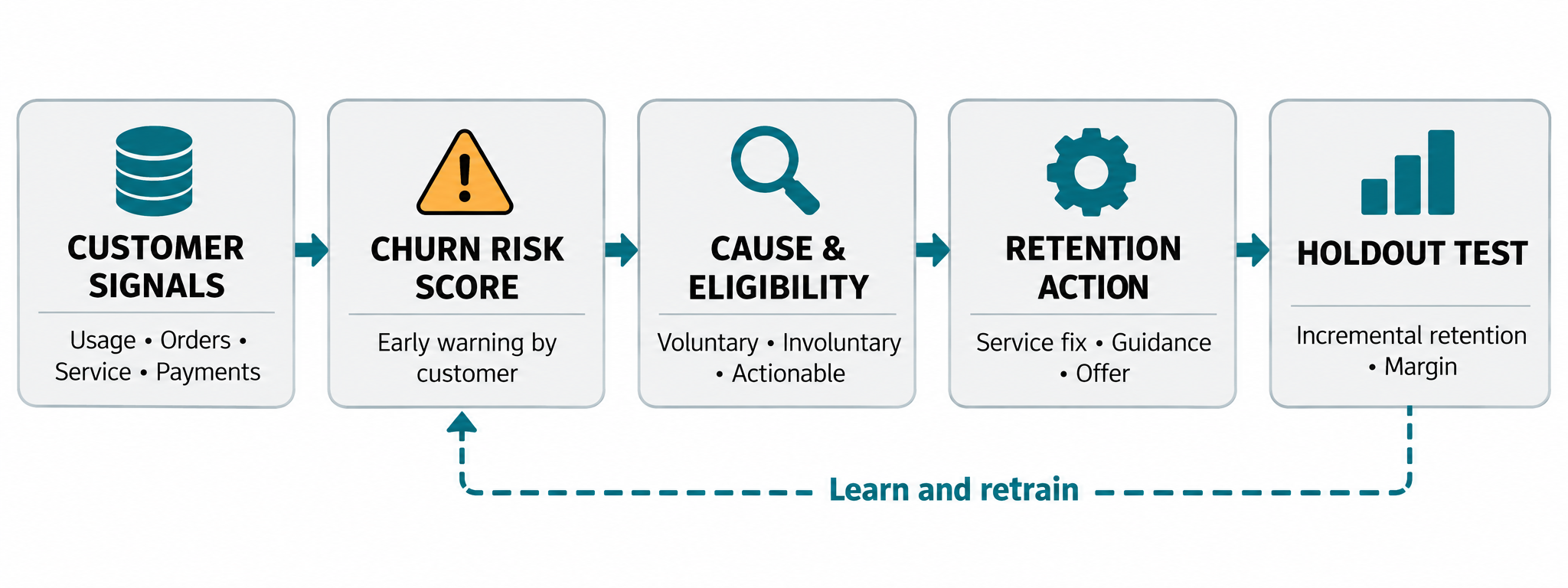
How predictive AI for churn separates voluntary and involuntary churn
Before building a model, divide churn into two types. The distinction changes both the data and the response.
Voluntary churn happens when a customer chooses to leave. Poor value, a weak experience, a competitor’s offer, or a change in needs may drive that choice. Marketing can sometimes influence this outcome through better service, a relevant offer, or a timely reminder of value.
Involuntary churn begins with a process failure. An expired card, a failed payment, or a delivery problem may end a relationship that the customer wanted to continue. Operations should fix these cases through payment retries, card-update prompts, and service recovery.
Combining both types in one campaign wastes money. For example, a discount cannot repair a failed payment. Likewise, a card reminder won’t help a customer who no longer sees value.
Choose early signals for predictive AI for churn
The best predictor is not always the most useful one. A cancellation-page visit may predict churn accurately, but it may leave little time to respond. Earlier signals often offer more practical value even when their accuracy is lower.
Start with the customer journey. Look for behavior that changes before a customer leaves, such as a streaming subscriber watching less often or a grocery subscriber pausing deliveries more frequently. A software account may lose active users or stop using a core feature.
Next, check whether each signal is available when the decision must happen. Monthly data cannot support a same-day intervention. In practice, the model’s refresh rate should match the speed of customer behavior and the cost of acting.
You should also monitor drift. Customer patterns change after price moves, product launches, and seasonal events. Google’s guidance on production machine learning explains why teams need monitoring and retraining after deployment.
Connect predictive AI for churn to a clear action
A useful churn brief names the decision before it names the model. Ask who receives an intervention, what action follows, how much the business can spend, and when a person should review the case.
One broad campaign rarely fits every cause. So match the action to the likely reason for leaving: a customer experiencing service failures may need recovery and an apology, while someone using fewer features may need guidance. A price-sensitive customer may need a different plan.
Timing matters as much as the offer. Contacting a customer too early can feel intrusive. Acting too late turns the model into a report about an outcome that has already happened.
Set boundaries as well. A retention system should make staying worthwhile. It should never make cancellation deliberately confusing or difficult. The NIST AI Risk Management Framework offers a useful structure for defining scope, human oversight, and production monitoring.
Test whether the intervention prevents churn
Prediction and prevention require different measurements. Model metrics tell you whether the system ranks risk well. Business experiments tell you whether the response changes behavior.
Create a randomized holdout group among eligible high-risk customers. The treatment group receives the intervention, while the holdout group receives the normal experience. Then compare retention, revenue, margin, and customer complaints across both groups.
This test protects you from a common mistake. Many high-risk customers will stay without an offer. If you discount every flagged customer, reported retention may look strong while profit falls.
Measure the result by segment too. An intervention may help new customers and annoy long-term ones. It may work for voluntary churn while doing nothing for payment failures. Segment-level results reveal where to expand, revise, or stop the program.
Use a simple predictive AI churn brief
You don’t need to specify an algorithm. You do need to give the data and technical teams a decision-ready brief.
Include these seven elements:
- Define the churn event and prediction window.
- Separate voluntary and involuntary churn.
- Identify signals available before the intervention deadline.
- Set risk bands and eligibility rules.
- Match each risk pattern to an appropriate action.
- Define spending, fairness, and approval limits.
- Measure incremental retention against a holdout group.
This brief keeps the project tied to a business outcome. It also prevents a technically impressive model from becoming an unused dashboard.
Move from prediction to customer value
Predictive AI for churn works best as part of a wider customer-value system. Churn probability informs retention, purchase propensity guides acquisition, and upgrade or downgrade signals support expansion. Together, these models help teams decide where attention can create the most value.
Start with one churn event and one intervention. Establish a baseline, run a controlled test, and learn which customers benefit. Once that loop works, expand the model to more segments or earlier signals.
For the broader capability map, read our AI marketing guide. You can also explore how AI is transforming MarTech before designing your first retention experiment.

