


Generative AI marketing tools can produce a dozen campaign variants before a creative team finishes its first review. That speed is useful. It can also multiply weak claims, tired ideas, and brand mistakes just as quickly.
The practical question is not whether a model can write copy or make an image. It is whether the system improves a marketing decision without creating more review work than it saves. Teams get better results when they assign generative AI a narrow role, provide strong inputs, and keep people accountable for the final output.
This guide explains where generative AI adds value, where it tends to fail, and how to build a controlled workflow for content and creative work.
What generative AI marketing actually does
Predictive models estimate what may happen next. Generative models create new material from patterns learned during training. That material can include text, images, audio, video, code, and structured data.
For marketers, this distinction matters. A churn model might rank customers by their risk of leaving, while a generative model drafts retention messages for approved customer groups. One system supports a prediction. The other produces an artifact that a customer may see.
You can explore that distinction in our AI marketing guide. Our guide to predictive AI for churn shows how prediction connects to a business action.
Generative AI works best when the brief defines the audience, task, evidence, constraints, and approval path. Without those inputs, a polished answer can still be irrelevant or wrong.
Where generative AI creates useful leverage
The strongest use cases reduce the cost of exploration or adaptation. They do not remove the need for a clear strategy.
Explore more creative directions
A team can use a model to sketch several campaign territories, headlines, storyboards, or visual treatments. This gives people more raw material to discuss at the start of a project. It is especially useful when a blank page slows the team down.
However, generated options are not concepts merely because they sound complete. A strategist still needs to judge whether an idea is distinctive, relevant, and credible. The model expands the search space; the team chooses where to go.
Adapt approved content
Once a core asset is approved, generative AI can help turn it into channel-specific versions. A long article might become an email introduction, a sales summary, a social caption, and a short video outline.
This workflow is safer than asking the model to invent every asset separately. The approved source gives each version a common factual base. Editors can then check whether the adaptation preserves the intended meaning.
Support language and format variation
Brands serving diverse markets often need content in several languages and formats. Generative tools can create a useful first draft for translation, localization, captions, summaries, and accessibility descriptions.
Yet language is more than word substitution. Idiom, humor, formality, cultural references, and product terminology require local review. In India, a campaign may also need different choices across languages, scripts, regions, and levels of digital familiarity. A fluent output is not proof of a suitable one.
Help teams work with content libraries
A model connected to an approved knowledge base can help employees find source material, summarize older assets, and prepare draft answers. This can reduce search time across product sheets, policies, research, and campaign archives.
The knowledge base must be maintained. If it contains expired offers or conflicting claims, the system may reproduce them with confidence. Content operations remain part of the solution.
Where generative AI marketing tends to fail
Generation becomes risky when a task requires factual certainty, original judgment, or sensitive context. Four failure modes deserve special attention.
First, models can produce false statements or fabricated details. A sentence may read well even when the source does not support it. Therefore, teams should trace product, price, performance, legal, and research claims to an approved source.
Second, outputs often converge on familiar patterns. A model trained on common material may give many brands the same tone, structure, and visual style. High output volume can then weaken distinction.
Third, prompts and reference files may expose confidential information. Employees should know which tools are approved and what data they may enter. Customer records, unreleased products, contracts, and private research need explicit controls.
Finally, generated material can create intellectual property, representation, and consent concerns. Teams need rules for training references, recognizable people, protected brand assets, and synthetic media. The answer will depend on the use case and jurisdiction, so legal review should examine defined risks and specific uses.
The NIST Generative AI Profile organizes risk work around governance, context, measurement, and management. It is a useful reference for teams designing controls. Google also warns that publishing many generated pages without adding user value may breach its policy on scaled content abuse. Its guidance on generative AI content makes the underlying issue clear: production volume alone does not create a content strategy.
Build a controlled content workflow
A reliable workflow separates creation from approval. It also makes ownership visible at each step.
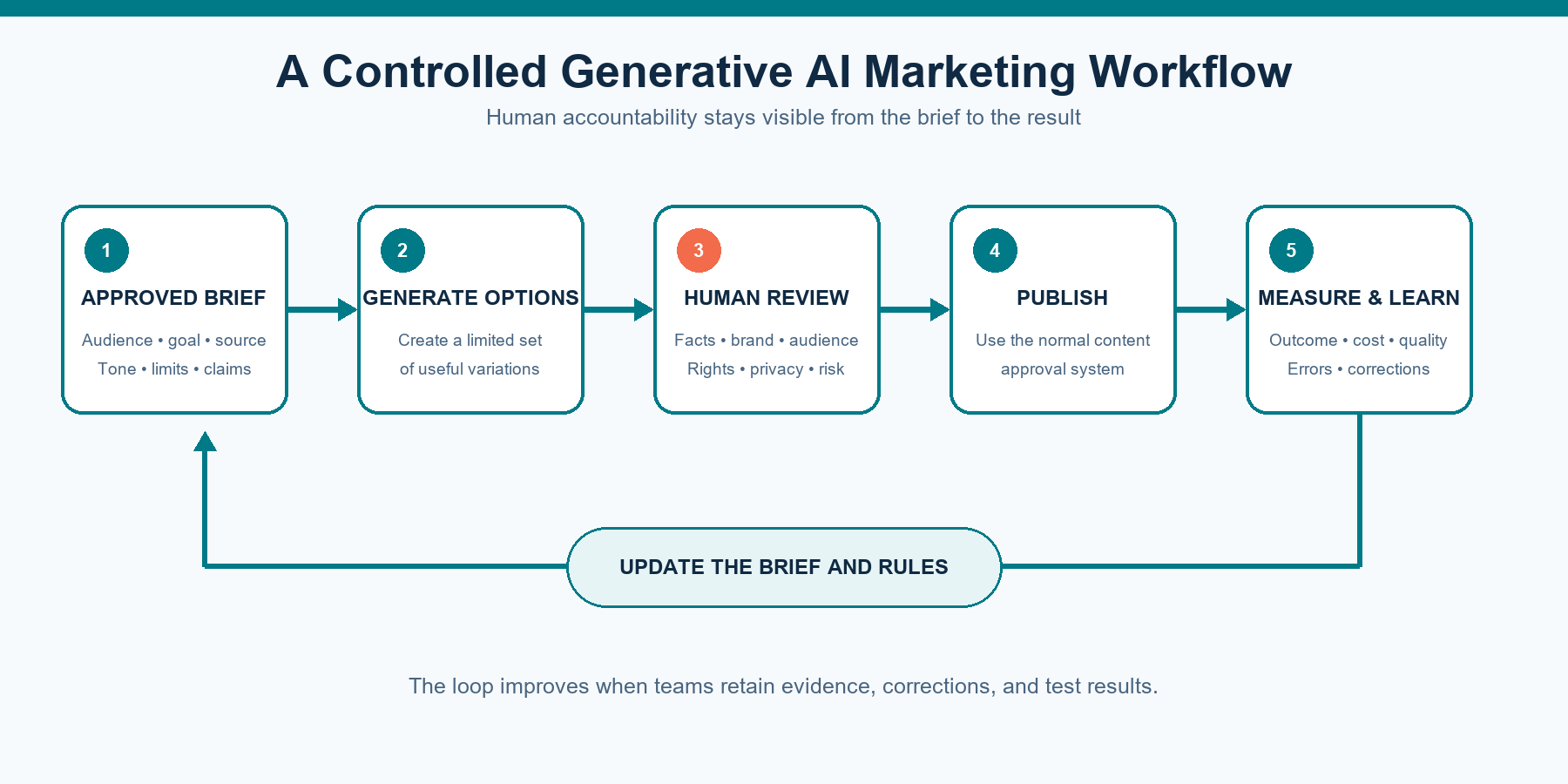
Start with an approved brief. It should state the audience, objective, offer, source material, channel, tone, and prohibited claims. Next, select a tool that fits the task and the data policy. Generate a limited set of options, then stop and review them before creating more.
The review stage should cover five questions:
- Accuracy: Does every factual claim match an approved source?
- Brand: Does the work sound and look like this brand rather than a generic category player?
- Audience: Is the message useful and appropriate for the intended reader?
- Rights and privacy: Are the inputs and outputs permitted for this use?
- Performance: What test will show whether the asset improves the intended result?
After approval, publish through the normal content system. Keep the brief, source material, model or tool version, reviewer, final asset, and test result together where practical. This record helps a team investigate errors and learn which workflows deserve wider use.
Measure value beyond production speed
Faster drafting is easy to observe, but it is not enough. A team may save an hour during creation and lose two hours during fact-checking, brand repair, or stakeholder review.
Measure the whole process. Useful operating measures include time from brief to approval, number of review rounds, proportion of drafts accepted, correction rate, and cost per approved asset. These figures reveal whether the tool reduces work or merely moves it downstream.
Then measure the marketing outcome. Depending on the task, that might include qualified traffic, conversion, engagement, recall, revenue, or retention. Use a valid comparison wherever possible. For example, test an AI-assisted asset against the normal production process while keeping the audience, offer, placement, and timing comparable.
Quality signals also matter. Track complaints, factual corrections, off-brand outputs, rights concerns, and accessibility failures. A workflow that lifts clicks but creates repeated trust problems is not performing well.
Choose the right level of human review
Not every asset needs the same approval path. Match review effort to the likely harm of an error.
Low-risk internal brainstorming can use light review. Public campaign copy needs brand and factual checks. Regulated claims, personalized financial or health messages, public statements, and realistic synthetic media need stricter controls and named accountability.
This risk-based approach keeps governance practical. If every draft faces the same committee, teams will bypass the process. If nothing receives careful review, serious errors will eventually reach customers.
Set clear boundaries for automation as well. A model may propose, summarize, or adapt material. It should not silently change a price, promise a product feature, impersonate a person, or publish a sensitive claim. The more consequential the action, the stronger the review should be.
Turn generative AI into a marketing capability
Generative AI creates value when it is part of a disciplined operating system. The system starts with good source material and a precise brief. It uses generation to explore or adapt. People then verify the result, approve its use, and measure the outcome.
Begin with one repeated, low-to-moderate-risk workflow. Record the current time, cost, quality, and result. Pilot the new process with a small team, then compare it with the baseline. Expand only when the evidence shows a real gain.
That approach may feel slower than giving everyone a tool and asking them to experiment. In practice, it creates reusable learning and protects the brand while the technology changes. Next, explore the broader Generative AI category as we add practical guides on governed content operations.

