


An AI marketing guide should help you choose the right capability for a real problem. Yet many guides start with tools. That approach can lead teams to buy expensive systems before they understand the job.
A churn model, a copy generator, and an autonomous campaign agent all use AI. However, they do very different work. They also fail in different ways. If you treat them as one category, you may use a complex tool where a simpler one would work better.
This guide offers a practical alternative. It explains four layers of marketing AI: classical machine learning, deep learning, generative AI, and agentic AI. More importantly, it shows where each layer fits and how marketers should govern it.
Why marketers need a working model of AI
Most marketers don’t need to build an AI model. They do need to commission, brief, and evaluate one.
That distinction matters. A marketing leader can specify a useful churn model without knowing how to code it. Still, the leader must define the business decision, available data, success measure, and acceptable risk.
The same rule applies to generative and agentic systems. A team must know what the system may do, what it must never do, and when a person must intervene.
AI literacy helps marketers make better choices without requiring mastery of technical language. The first choice is selecting the lowest capability that can solve the problem.
The four layers in this AI marketing guide
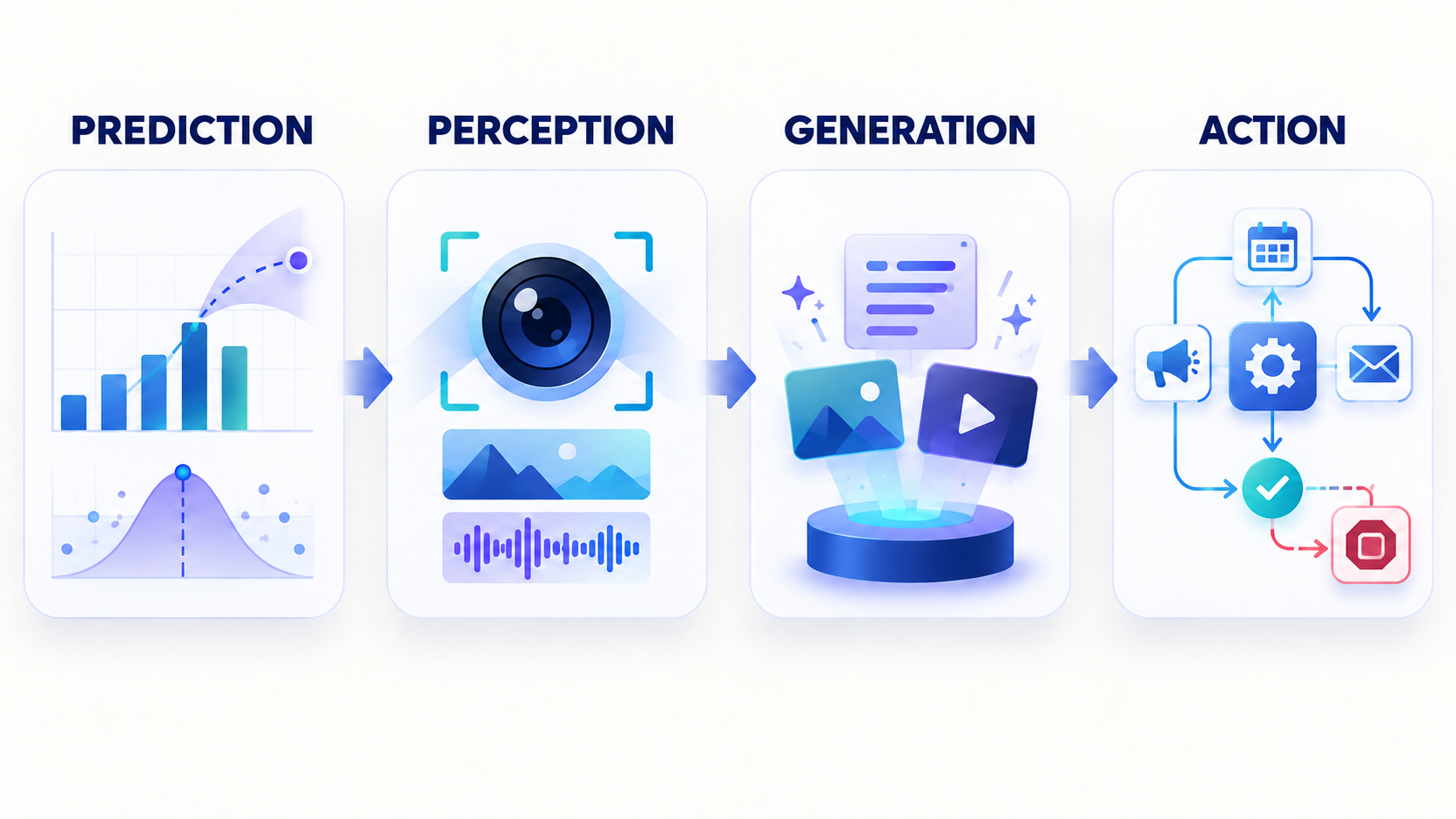
The four layers aren’t simply steps from basic to advanced. Each performs a different kind of work. As a result, each needs a different brief and control system.
1. Classical machine learning predicts
Classical machine learning finds patterns in structured data. It usually produces a score, probability, group, or forecast.
Marketing teams use it for customer segmentation, churn prediction, propensity scoring, lead scoring, look-alike modeling, and customer lifetime value. These uses may sound less exciting than a chatbot. Even so, they often connect more directly to a business decision.
Its main weakness is drift. Customer behavior, prices, channels, and competitors change. Consequently, a model trained on yesterday’s patterns can become less accurate while still producing confident scores.
Google’s guidance on production machine learning notes that almost all models become stale. Teams should therefore compare predictions with actual outcomes and retrain models at a cadence suited to the data.
Bias is another risk. A model can learn unwanted patterns from historical data. Marketers should test results across relevant customer groups alongside the overall accuracy score.
2. Deep learning perceives
Deep learning works well with unstructured information such as images, audio, text, and behavioral sequences. It powers visual search, speech recognition, content moderation, and some recommendation systems.
For example, a retailer may use image recognition to help shoppers find visually similar products. A social platform may use language and image models to identify harmful content.
However, these systems often need large, representative datasets. Their decisions can also be difficult to explain. That creates a problem when a customer, executive, or regulator needs to understand why an outcome occurred.
Use deep learning when ample, representative data are available and the perception task matters. Also ask whether a simpler, more transparent method could meet the same need.
3. Generative AI produces
Generative AI creates text, images, audio, video, and other content from instructions. It can help teams produce first drafts, creative variations, summaries, research aids, and conversational responses.
The economic appeal is clear. Once a workflow is established, a team can generate many variations quickly. However, speed does not guarantee truth or brand quality.
The NIST Generative AI Profile describes how generative systems can confidently present false content. Marketers often call this a hallucination. Because the output sounds convincing, an unchecked error may reach a campaign, product page, or regulated claim.
A brand can also lose its distinctive voice. If every team uses similar prompts and models, brands can begin to sound alike. A strong workflow therefore needs factual review, clear brand examples, provenance records, and named approval owners.
4. Agentic AI acts
Agentic AI goes beyond creating an output. It can plan and execute a sequence of actions through connected tools.
For instance, an agent might analyze campaign data, suggest a budget change, generate new creative, launch a test, and respond to the result. This can reduce manual work. At the same time, every new permission increases the possible cost of a mistake.
An agent may follow a badly defined goal, respond to a malicious instruction, or call paid services repeatedly. Therefore, teams need spending limits, permission boundaries, logs, approval checkpoints, and a reliable stop mechanism.
The key question isn’t whether an agent can act. Instead, ask what it may do without human approval.
How this AI marketing guide selects the lowest sufficient layer
Teams often reach for the newest technology because it appears more capable. However, the highest layer isn’t always the best layer.
Suppose a subscription business wants to identify customers likely to cancel. A classical churn model may solve that problem well. A large language model adds cost and may provide less reliable scores.
Now suppose the same business wants personalized retention emails. A generative model can draft variations, while the churn model identifies the audience. The two layers work together, but they don’t replace each other.
Finally, suppose the company wants a system to select an offer, write the message, send it, and adjust future offers. That is an agentic workflow. It may create more value, but it also receives more authority.
This leads to a useful rule: match autonomy to the cost of error. A low-risk internal draft may need light review. A public claim, price change, media purchase, or message to a distressed customer needs tighter control.
Learn from the Klarna customer-service example
Klarna’s 2024 customer service deployment shows both the scale and the need for careful interpretation.
According to OpenAI’s Klarna case page, the assistant handled 2.3 million conversations in its first month. That represented two-thirds of customer service chats. OpenAI also reported that the average resolution time fell from 11 minutes to under two minutes.
Those figures came from a company case study. They are reported operational results and do not independently prove that the same design will work elsewhere. The more useful lesson is about task boundaries.
High-volume, repeatable requests are easier to automate than complex cases requiring empathy or discretion. Therefore, teams should map tasks by both frequency and cost of error before setting an automation target.
Build, buy, or rent the capability
After choosing the layer, decide how to source it. The answer depends on differentiation, data, integration, and control.
Rent embedded or platform capability when the task is common and not strategically distinctive. For example, a standard transcription or draft-summary feature rarely justifies a custom build.
Buy a specialized product when a vertical need requires domain workflows, integrations, or controls that a general platform lacks. Even then, test how the product uses data and how easily your team can migrate away from it.
Build custom capability when the use case is genuinely differentiating and your organization has a proprietary data advantage. Without that advantage, a custom build may recreate a commodity at a higher cost.
In practice, many organizations will use all three approaches. The goal isn’t technical purity. It is a portfolio that balances value, control, speed, and risk.
Use the AI marketing guide to write a better brief
A useful brief starts with the problem. Tool selection comes later. Before speaking with a vendor or technical team, answer six questions.
- What decision or task should improve?
- Which AI layer is the lowest one that can solve it?
- What data will the system use, and who owns that data?
- How will the team measure success against a current baseline?
- What must the system never do while pursuing the goal?
- Where must a human review or approve its work?
These questions force a team to connect capability with responsibility. They also make vendor comparisons easier because every option answers the same business brief.
The NIST AI Risk Management Framework reinforces this approach. It calls for teams to define the system’s task, scope, expected costs, human oversight, and production monitoring.
What marketers should do next
Start with one marketing problem and classify it. Is it a prediction, perception, production, or action problem?
Then choose the lowest sufficient layer and write the six-part brief. Only after that should you compare products or decide whether to build.
This AI marketing guide makes adoption less theatrical and more useful. It also gives marketing leaders a clear role: own the problem, the performance measure, and the boundaries within which the capability operates.
Explore the AI Marketing category for the growing foundation series. You can also read how AI is transforming MarTech before moving to the next guide on predictive AI.

